The technologies behind modern games are changing faster than ever. Game engines are becoming sophisticated real-time development platforms. Artificial intelligence is transforming how digital assets are created and tested. Virtual and augmented reality are opening new possibilities for immersive experiences. Procedural generation is enabling developers to create increasingly complex environments, while real-time 3D is extending beyond entertainment into simulation, visualization, training and other interactive applications.
Map Factory explores the technologies, disciplines and ideas shaping this rapidly evolving landscape.
When constructing real-time lighting passes, complex character physics, or massive open-world spatial partitions, developers routinely rely on the Epic Developer Community — Unreal Engine Docs. Referencing these official technical specs helps validate your articles whenever you discuss shaders, level geometry optimization, or rendering pipelines.
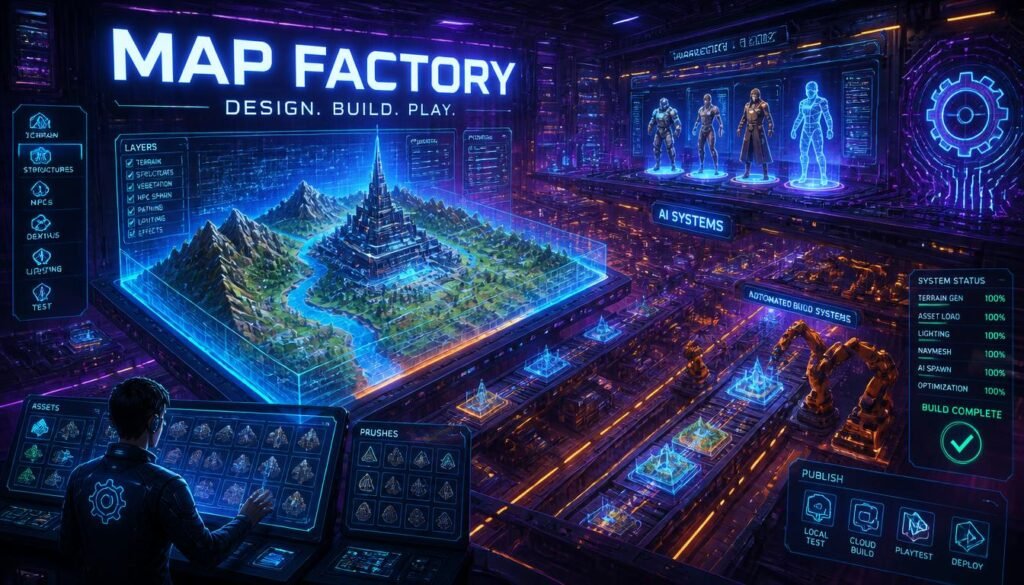
Explore the Map Factory Digest for the latest developments shaping game development, game engines, 3D worlds and interactive technology. Map Factory Digest brings together fresh insights, emerging trends and practical perspectives for developers, designers and technology enthusiasts exploring the future of digital experiences.
Originally associated with the PC gaming and level-design community, Map Factory built its identity around custom game maps, user-created environments, level design and the creative work that made classic PC games endlessly adaptable. That heritage remains central to the publication today. Map Factory has evolved from a destination focused on individual game maps into a modern source of insight covering game development, game engines, level design, virtual worlds, 3D graphics and interactive technology.
Our focus is simple: understand how digital worlds are built, how interactive experiences are engineered and where the technologies behind them are heading next.
Whether you are a game developer, technical designer, 3D artist, software engineer, technology professional, researcher, studio leader or simply interested in the future of interactive digital experiences, Map Factory provides practical, informed coverage designed to help you understand the technology behind the experience.
Exploring the Technology Behind Digital Worlds
A modern digital world is the result of hundreds of interconnected decisions.
Developers need to think about gameplay, rendering, physics, artificial intelligence, asset creation, performance, networking, user experience and platform compatibility. Designers need to create environments that are visually compelling while also supporting navigation, interaction and meaningful player behavior. Technical teams need to ensure increasingly complex experiences operate efficiently across a growing range of hardware.
The result is a development ecosystem that extends far beyond traditional game creation.
Technologies originally developed for games are increasingly influencing visualization, simulation, virtual production, architectural experiences, training environments and other interactive applications. Real-time 3D engines can now produce highly detailed environments, while advances in graphics hardware and computational power continue to raise expectations for visual fidelity and responsiveness.
Map Factory examines this ecosystem from the perspective of the technologies and practices that make these experiences possible.
We look beyond surface-level trends to explore how systems work, why particular development approaches matter and what emerging technologies could mean for the future of interactive environments.
Game Development & Design
Game development sits at the heart of Map Factory.
Creating a successful interactive experience requires much more than compelling graphics. Developers and designers must combine creative direction with engineering, production, testing and technical optimization. A well-designed game needs systems that work together seamlessly, environments that support the intended experience and technology capable of delivering those experiences consistently.
Map Factory explores the complete game development landscape, from early concepts and prototypes through development, testing, optimization and deployment.
Our coverage examines game design principles, development workflows, gameplay systems, production methodologies, prototyping, player experiences and the technologies supporting modern development teams.
We are particularly interested in how development practices are evolving.
Artificial intelligence, procedural generation, increasingly capable development tools and real-time technologies are changing how teams approach projects. Smaller studios can access capabilities that were once restricted to major publishers, while established development organizations are exploring new ways to improve production efficiency without compromising creativity.
Understanding these changes requires looking at both the technology and the people using it.
Map Factory therefore examines the practical realities of modern development, including the opportunities, limitations and strategic decisions involved in building increasingly sophisticated interactive experiences.
Game Engines & Development Technology
The modern game engine is much more than a tool for displaying graphics.
Today’s engines can provide sophisticated rendering, physics, animation, audio, networking, artificial intelligence and development frameworks within a unified environment. They allow teams to construct complex interactive experiences while reducing the need to develop every underlying technology from scratch.
Map Factory examines the evolution of game engines and the technologies that power them.
We explore real-time rendering, engine architecture, development frameworks, physics systems, graphics technologies, performance optimization and cross-platform development. We also examine how game-engine technology is increasingly being applied outside conventional gaming.
The growing importance of real-time technology means game engines are becoming relevant to an expanding range of industries. Interactive visualization, simulation, virtual production and immersive environments can all benefit from technologies originally refined through decades of game development.
This convergence creates interesting questions.
How should development teams select an engine for a particular project? When does real-time rendering provide advantages over traditional workflows? How are modern graphics technologies affecting development pipelines? What happens when game-engine technology becomes the foundation for applications that were never designed as games?
Map Factory investigates these questions while following the continued evolution of the development platforms shaping interactive computing.
Level Design & Virtual Worlds
Maps were where Map Factory began, and the design of digital environments remains one of our defining areas of interest.
Level design is a discipline that combines architecture, storytelling, gameplay, navigation, visual communication and systems thinking. A successful environment needs to look convincing while also guiding users through an experience and supporting meaningful interaction.
Modern level design has become increasingly sophisticated.
Open-world games can contain enormous environments with interconnected systems, dynamic events and procedural elements. Multiplayer environments must account for player behavior, competition, cooperation and performance. Virtual worlds can extend beyond conventional game spaces to create persistent environments designed around exploration, social interaction, simulation or training.
Map Factory explores the principles behind these environments.
We examine world building, environmental design, procedural generation, spatial design, open-world development and virtual environments. We also consider how concepts developed through game-level design are influencing broader areas of interactive technology.
The distinction between a “game map” and a sophisticated digital environment is becoming increasingly difficult to define.
A virtual environment can now function as a place for entertainment, education, collaboration, simulation or visualization. As spatial computing and immersive technologies develop, the principles used to design compelling game environments may become increasingly important across the wider digital economy.
That evolution makes level design more relevant than ever.
3D Graphics & Digital Environments
Visual computing has undergone a remarkable transformation.
Modern hardware can render detailed environments, complex lighting, realistic materials and highly sophisticated visual effects in real time. Meanwhile, advances in 3D modeling, texturing, animation and rendering continue to expand what developers and digital artists can create.
Map Factory examines the technologies behind these digital environments.
Our coverage includes 3D graphics, modeling, rendering, digital assets, lighting, animation, visualization and real-time graphics. We explore the relationship between artistic production and technical implementation, because creating a convincing digital environment requires both.
The development of 3D assets has also changed dramatically.
Tools are becoming more accessible, workflows are becoming increasingly automated and artificial intelligence is beginning to influence asset creation and content production. At the same time, expectations for visual quality continue to increase.
This creates a challenging balance for development teams.
Higher visual fidelity can demand greater computing resources, larger development teams and more complicated production pipelines. Developers therefore need to consider not only how an environment looks but also how efficiently it can be produced, rendered and delivered.
Map Factory explores these challenges and the technologies helping developers overcome them.
We are particularly interested in the movement toward real-time 3D and the growing use of interactive visualization outside traditional gaming. The same technologies that allow a game to display a detailed environment can increasingly be used to create simulations, virtual experiences and other forms of digital visualization.
Interactive Technology & Gaming Innovation
Interactive technology is moving into a new era.
Artificial intelligence, extended reality, spatial computing, immersive interfaces and real-time simulation are changing how people interact with digital environments. The boundaries between gaming, simulation, visualization and other interactive experiences are becoming increasingly fluid.
Map Factory follows these developments with a focus on practical technological implications.
Artificial intelligence is one of the most significant forces influencing the industry. AI-assisted development can affect everything from game testing and procedural content generation to asset creation, character behavior and development workflows. The long-term impact will depend not only on what AI can produce but also on how development teams integrate these capabilities into existing processes.
Extended reality introduces another major area of change.
Virtual reality, augmented reality and mixed-reality technologies can place users inside digital environments or blend digital information with the physical world. As hardware and software improve, developers are exploring new approaches to interaction, spatial interfaces and immersive experiences.
Spatial computing extends this evolution further by treating digital information and physical space as increasingly connected.
Map Factory examines these developments through the lens of interactive technology, asking where emerging technologies are genuinely creating new capabilities and where they are simply introducing new terminology around existing concepts.
Where Gaming Technology Meets the Wider Digital World
The influence of gaming technology is no longer limited to games.
Real-time rendering can support visualization. Game-engine technology can power simulations. Virtual environments can support training. 3D technologies can create interactive presentations of complex information. Immersive systems can provide new approaches to education, collaboration and digital experiences.
This convergence is one of the most important developments we follow at Map Factory.
The gaming industry has spent decades solving difficult technical problems involving real-time graphics, physics, artificial intelligence, networking and interactive environments. As other industries increasingly demand real-time and immersive experiences, many of these capabilities are becoming relevant beyond entertainment.
The result is a broader interactive technology ecosystem.
Map Factory explores this convergence without losing sight of its original focus. Games remain an important source of innovation, experimentation and technological development, but the ideas generated within gaming increasingly have applications elsewhere.
Understanding where those technologies originated can provide useful context for understanding where they may go next.
The Evolution of Map Factory
Map Factory has its roots in an earlier generation of PC gaming.
During the era when custom maps and community-created content were an important part of PC gaming culture, independent websites provided players and creators with access to user-generated environments for some of the most influential games of the period. Map repositories gave level designers a place to share their work and players a way to discover new experiences beyond the original content shipped with a game.
That culture helped establish many of the principles that continue to influence interactive development today.
Community creativity. Modding. User-generated content. Level design. Custom environments. Experimentation with game engines.
The technology has changed considerably, but those principles remain relevant.
Map Factory builds on that heritage while looking forward. The modern publication is not simply an archive of classic gaming content. It is a technology-focused platform examining the disciplines and innovations that evolved from the same creative foundations.
From custom game maps to procedural worlds. From traditional game engines to real-time development platforms. From static 3D assets to dynamic digital environments. From conventional gaming experiences to spatial and immersive computing.
The evolution continues.
Built for Developers, Designers and Technology Professionals
Map Factory is written for readers who want more than superficial coverage.
Our audience includes game developers building new experiences, designers creating digital environments, engineers working with real-time technologies, artists producing 3D content, technology leaders evaluating emerging platforms and professionals interested in the convergence of gaming and interactive computing.
We aim to make complex subjects understandable without reducing them to simplistic explanations.
Technical subjects deserve context.
A discussion about a game engine should consider its development ecosystem and practical applications. A discussion about artificial intelligence should consider how the technology affects actual workflows. A discussion about virtual reality should consider interaction, hardware and software rather than simply describing the technology as “immersive.”
Our editorial approach therefore emphasizes practical relevance, technical understanding and long-term significance.
We are interested in what technologies can actually accomplish, how they are being implemented and what developers and organizations should understand before adopting them.
Original Thinking for a Changing Technology Landscape
Technology moves quickly, but not every trend deserves equal attention.
Map Factory focuses on developments that have the potential to influence how interactive experiences are designed, developed and delivered.
That means examining established technologies alongside emerging ones.
Some innovations will become fundamental components of future development workflows. Others will prove less significant than early predictions suggest. Separating meaningful technological change from short-lived hype requires analysis, context and an understanding of how development ecosystems actually operate.
This is particularly important as artificial intelligence, real-time 3D, spatial computing and immersive technology continue to develop simultaneously.
Map Factory aims to provide that perspective.
Our objective is not to predict the future with certainty. It is to identify the technologies, development practices and creative disciplines most likely to shape it, then examine how those changes could affect the people and organizations building the next generation of digital experiences.
A Publication Focused on What Comes Next
The future of interactive technology will not be defined by one platform or one innovation.
It will emerge from the convergence of multiple technologies and disciplines.
Artificial intelligence will influence development workflows. Game engines will continue evolving into broader real-time platforms. 3D graphics will become increasingly accessible and sophisticated. Virtual and augmented reality will continue experimenting with new interaction models. Procedural generation will help developers construct increasingly complex environments. Spatial computing will challenge conventional ideas about how digital information is presented and experienced.
At the center of these developments will remain a familiar idea: building digital worlds that people can interact with.
That is the connection between Map Factory’s past and its future.
The tools have changed. The hardware has changed. The scale of digital environments has changed. But the underlying creative challenge remains remarkably consistent: create an environment, make it interactive, give it purpose and build technology capable of bringing the experience to life.
Map Factory exists to explore how that challenge is being solved today.
Explore Map Factory
From game development and game engines to level design, 3D graphics, virtual worlds and emerging interactive technologies, Map Factory provides a focused destination for understanding the systems behind modern digital experiences.
Explore practical perspectives on Game Development & Design, discover how Game Engines & Development Technology are evolving, examine the principles behind Level Design & Virtual Worlds, understand the technologies powering 3D Graphics & Digital Environments, and follow the innovations shaping Interactive Technology & Gaming Innovation.
Whether you are building a game, designing a virtual environment, evaluating development technology or simply interested in where interactive computing is heading, Map Factory provides a place to explore the ideas, technologies and practices shaping the next generation of digital worlds.
The map is no longer just a level. It is the beginning of an entire digital environment. Map Factory explores what comes next.